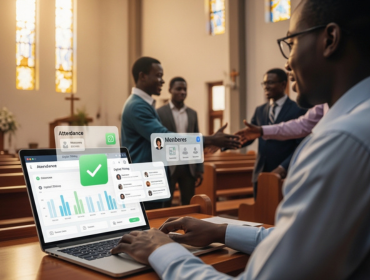
On a busy Sunday morning in Accra, the service has just closed. The ushers are huddled over a dog‑eared attendance book, trying to tally numbers before they fade from memory. In the office, two stewards are counting notes and coins for the third time because the figures on the paper don’t match what they remember from the offering bowl. A deacon wants to follow up on a young couple who visited last month, but no one can find the small notebook where their names were written. By the time everyone is done, it’s late, they are tired, and some details are simply lost.
Many Ghanaian churches know this scene too well. We love God, we love people, but our records are often scattered across exercise books, loose sheets, WhatsApp chats, and people’s memories. In a world where almost every member carries a smartphone, this doesn’t have to be our reality anymore.
Why Manual Record-Keeping Is Holding Ghanaian Churches Back
Manual systems feel familiar. Most of us grew up seeing pastors and secretaries faithfully keeping registers and financial books by hand. But as churches grow and life becomes busier, manual record‑keeping quietly works against us in several ways:
- Lost or damaged books – One spilled drink, one rainstorm on a trotro, or one misplaced box during a move, and years of attendance and finance history can disappear.
- Human errors – Tired volunteers can miscount offerings, repeat or skip names in the attendance book, or record figures in the wrong column.
- Slow reporting – When the district, area, or headquarters requests statistics, leaders scramble to flip through multiple books to compile numbers.
- Poor follow‑up – Visitor cards and membership slips get buried in files. People who were eager after a powerful service can easily fall through the cracks because we cannot find their details.
- Limited insight – Paper books make it hard to see patterns. Are young adults dropping off? Is mid‑week service growing? Which departments are most active? Manual systems rarely give us a clear picture.
In a small congregation, these issues may seem manageable. But as soon as you introduce multiple services, branches, departments, and a steady flow of visitors, the weaknesses of manual systems become obvious. Time that could be spent on prayer, counselling, and ministry is spent chasing books, re‑counting money, and hunting for phone numbers.
The Opportunity: What Digitizing Attendance Looks Like in Practice
Digitizing attendance does not have to mean buying expensive biometric machines or hiring an IT consultant. At its heart, it simply means using digital tools—often the phones and laptops you already have—to capture and store who is coming, when, and where.
Here is how it can look in a typical Ghanaian church:
- Ushers with simple forms – Instead of passing around a paper register, ushers can use a smartphone or tablet with a simple attendance form. Members can be checked in by tapping their names from a list or scanning a unique code.
- Visitors captured neatly – First‑timers can fill a short digital form on a tablet at the ushers’ desk or via a QR code on a banner or projector. Their details go straight into a secure online list, ready for follow‑up.
- Multiple services, one database – Whether you have English and Twi services, youth meetings, or weekday prayer sessions, all attendance records feed into one system. You can filter by service, date, age group, or department.
- Automatic summaries – Instead of counting lines in a book, you can see total attendance for a month, quarter, or year in a few clicks. Trends become visible without extra work.
When attendance is digital, leaders can quickly identify members who have been absent for several weeks, track the impact of outreach programs, and plan better for seating, transport, and volunteers. It moves attendance from being a ritual to being a real tool for pastoral care.
Handling Tithes and Offering Records Digitally (Including MoMo)
Finances are sensitive in every church. Members want to know that their tithes and offerings are handled with integrity, and leaders want systems that make it easy to account for every pesewa.
In Ghana today, many people give via mobile money—MTN MoMo, Vodafone Cash, AirtelTigo Money—and still others prefer cash. A digital approach can respect both:
- Digital giving channels – Your church can publish official MoMo numbers or bank accounts on flyers, banners, and slides. Members can give from home or during service, and the transactions are automatically recorded by the network or bank.
- Recording cash systematically – Ushers and finance stewards can enter cash collections into a digital record right after counting. Instead of writing totals in a book, they log the amount, service, date, and category (tithes, missions, welfare, etc.) into a simple system.
- Combining MoMo and cash – A church management system can bring MoMo and cash together into one dashboard. On a given Sunday, you can see total giving by type, and over time, you can accurately track trends.
- Clear reporting – With digital records, treasurers can prepare financial reports for boards, districts, and auditors without rewriting figures over and over.
When systems are set up well, digital records actually strengthen trust. There is less room for confusion or suspicion because every transaction is traceable, reports match mobile money statements, and leaders can confidently show how funds are used for ministry.
Managing Member Records: More Than Just Names in a Book
Member records are the heart of pastoral ministry. They are more than names; they tell the story of people’s journeys with God in your church.
A digital membership database can capture details like:
- Full name and preferred name
- Phone numbers and email
- Residential area and hometown
- Date of baptism or confirmation
- Department or ministry (choir, ushers, youth, women’s fellowship, media, etc.)
- Cell group or family unit
- Marital status and important family connections
Instead of flipping through multiple membership booklets, a pastor can:
- Quickly pull a list of all youth leaders for a training meeting
- See which new converts have not yet been baptized
- Identify members in a particular area for house fellowship or outreach
- Update details when someone changes number or moves house
During emergencies—such as a member being ill, travelling, or bereaved—a well‑maintained digital record helps the church respond faster and more personally. It also helps ensure that no one quietly disappears without anyone noticing.
“But Our Church Is Not Tech-Savvy” – Addressing Common Objections
The moment digitization is mentioned, many leaders feel a mix of interest and fear. Common concerns include:
- “It will be too expensive.”
- Not every church needs a custom‑built system. Many affordable, even free‑to‑start, solutions exist. The real cost is not the software but the time we lose and the opportunities we miss when our records are in chaos.
- “Our leaders and members are not good with technology.”
- Most of your congregation already uses WhatsApp, Facebook, and MoMo. If they can send a voice note or do a MoMo transfer, they can learn to tap a simple attendance button or fill a short form. Start small, train patiently, and choose tools designed with churches in mind.
- “What about security and privacy?”
- Paper books left on desks or in unlocked cabinets are actually less secure than properly managed digital systems. With the right tools, you can control who has access to which information and keep backups in case a device fails.
- “We don’t have constant internet.”
- Some church systems allow offline data capture that syncs when there is connectivity. Even a weekly internet connection in the office can be enough to keep things updated.
The key is to choose a solution tailored for churches, with simple dashboards and forms that reflect real church life instead of forcing you to think like a corporate office.
Choosing Simple, Church-Friendly Tools
You don’t have to stitch together many unrelated apps and spreadsheets. A dedicated church management system can bring attendance, giving, and member records into one place so your team is not jumping between multiple tools.
A platform like this is designed for:
- Tracking Sunday and weekday attendance by service, age group, and department
- Recording both cash and mobile money giving in a consistent way
- Managing detailed member profiles, family links, and ministry involvement
- Generating reports for leadership meetings, district reviews, and annual audits
If your church is ready to explore such a system, you can look at solutions built specifically for Ghanaian and African churches, such as the one available on flocksuite.com. It is built to help churches move their core records online without needing to be “IT experts” first. When you’re ready to try it, you can even start a free registration journey at this link: https://flocksuite.com/church/register.
Practical First Steps Your Church Can Take This Week
Digitization does not have to be a giant leap. It can be a journey of small, wise steps. Here are practical actions you can begin this week:
- Appoint a small digital team.
- Identify two or three reliable people—perhaps a church administrator, a youth leader, and someone from the finance team—who are willing to champion this transition.
- Audit your current records.
- Gather all attendance books, tithe records, department registers, and membership lists. Note what information you are already collecting and where the biggest gaps and frustrations are.
- Decide on one area to digitize first.
- Don’t try to change everything at once. You might start with Sunday attendance, or with new visitor records, or with tithes and offerings. A quick win will build confidence.
- Test a simple digital form or system.
- Create a short online form for visitors, or start entering this month’s attendance into a church management system dashboard. Let a few ushers or leaders try it and give feedback.
- Train and communicate.
- Spend 15–20 minutes after a mid‑week service walking key volunteers through the new process. Explain to the congregation why the church is going digital: not to control them, but to serve them better.
- Set a clear routine.
- For example, ushers submit attendance digitally within 15 minutes after each service. Finance stewards log offerings the same day. The secretary reviews new visitor records every Monday and schedules follow‑up calls.
- Review after one month.
- Sit with your digital team and ask: What has improved? What is still difficult? Adjust the process and, if needed, expand to other areas like mid‑week services or departmental meetings.
By moving steadily, your church will discover that digital systems actually reduce workload over time. Volunteers spend less energy copying numbers and more energy caring for people.
Digitization as Stewardship, Not Just Technology
For many pastors and leaders, the word “technology” can feel foreign or even threatening. But digitizing your attendance, tithes, and member records is not about being trendy; it is about stewardship.
Scripture reminds us, “Let all things be done decently and in order” (1 Corinthians 14:40, KJV). Order is not just about how we conduct the service; it is also about how we handle the people and resources God has entrusted to us. Clear, accurate records help us care for souls, plan wisely, and account faithfully for finances.
Jesus also said, “He that is faithful in that which is least is faithful also in much” (Luke 16:10, KJV). Names on a register, figures in an offering report, dates of baptism—these may seem like “little things,” but they speak of real lives and real sacrifices. When we handle them well, we honour God and build trust with His people.
Digitization is simply using today’s tools to practice yesterday’s principles: faithfulness, integrity, and good order. When your church embraces this, you are not becoming less spiritual; you are creating more room for focused spiritual work.
A Final Encouragement to Church Leaders
If you feel overwhelmed by the idea of changing your systems, you are not alone. Many Ghanaian churches are on the same journey. The good news is that you do not have to be perfect before you start.
Begin with what you have—one smartphone, one laptop, a few committed volunteers—and take the first step. As you do, you will soon see fewer missing records, clearer financial reports, and more intentional follow‑up on the people God brings through your doors.
As you consider tools and systems—whether simple forms or a full church management platform like the one on flocksuite—remember that the goal is not to impress anyone, but to serve God’s people better.
May the Lord grant you wisdom as you lead your church into this new season of order, transparency, and care. And as you put structures in place, may your members feel even more seen, valued, and shepherded in the house of God.

Comments
No comments yet. Be the first to share your thoughts!
Leave a Comment