

Church Management Software Kumasi: A Practical Guide
Church management software Kumasi is no longer a luxury for Ashanti churches. It is the difference between knowing your members by name and guessing at your own growth.
Kumasi is Ghana's second city and the heart of the Ashanti Kingdom. The 2021 population census puts the Ashanti Region at 5.4 million people, the most populous region in the country. Around 71% of Ghanaians identify as Christian, and Pentecostal and Charismatic churches are the single largest group at 31.6%. Walk through Adum, Bantama, or Atonsu on a Sunday morning and you will pass a dozen churches before lunch. Most of them still run on paper registers and WhatsApp groups.
This guide explains what church management software Kumasi churches actually need, what it costs in cedis, and how to choose without wasting money. If you want to skip the detail, you can start a free 14-day trial with FlockSuite, no credit card required.
What Church Administration Looks Like in Kumasi Today
A city of dense congregations and long service lists
Kumasi's church scene is dense and layered. The mainline denominations have deep roots here. Methodist, Presbyterian, Catholic, and Anglican churches sit alongside the Church of Pentecost, Assemblies of God, ICGC, Winners Chapel, and Christ Apostolic Church. The Church of Pentecost alone reports more than 4.2 million members worldwide across roughly 21,800 local assemblies, and its headquarters is in Ghana. Ashanti is one of its strongest regions.
A typical Kumasi church runs at least two services on a Sunday, often three. A first service at 6am for early risers, a main service at 9am or 10am, and sometimes a youth or English service in the afternoon. Midweek brings prayer meetings, Bible study, choir practice, and cell group meetings in homes across the city. Then come the seasonal rhythms every Kumasi pastor knows: harvest celebrations, conventions, all-night services, and revival weeks. Each one generates its own paperwork.
The paper register and WhatsApp status quo
For most of these churches, administration still happens the old way. Members are written in a hardcover register. Attendance is marked in a service book. Visitors fill a card on their way in. Giving is recorded in an exercise book, while mobile money transfers arrive on the treasurer's phone. Announcements go out on a WhatsApp group that nobody can fully search.
None of this is laziness. It is what the previous generation handed down, and it worked when the church had 80 members. The problem is that Kumasi churches do not stay at 80 members for long. Growth changes the arithmetic, and paper does not scale.
Church Management Software Kumasi: Why Ashanti Churches Switch
Attendance books that hide decline until it is too late
A church in Atonsu runs three Sunday services. For six months the secretary recorded attendance in three separate books, one per service. When she finally typed the numbers into a spreadsheet, she found the second service had been shrinking quietly for three months. The pastor never noticed, because he only ever saw the combined headcount at the end of the day, and the total looked healthy.
That is what a paper register does. It buries the trend inside the tally. Church management software separates attendance by service, by department, and by age group, and it shows you the trend line the moment it starts to bend, not six months later.
Visitor cards that never get a callback
At a church in Bantama, first-time visitors fill a card and hand it to the ushering team. The cards go into a folder on the secretary's desk. By Tuesday the folder is under a stack of hymn books. Three out of four visitors never hear from anyone again.
Most churches lose 60 to 70 percent of first-time visitors within four weeks, and the reason is almost never the sermon. It is that nobody called them back. A visitor follow-up system is the most underrated feature of any church management platform. When a visitor's name and phone number go straight from the welcome card into a database with a follow-up reminder, the callback actually happens.
Member records scattered across phones and notebooks
Ask any church secretary in Kumasi where the member list lives and you will get a nervous laugh. Part of it is in the register. Part of it is on the pastor's phone. The youth list sits on a WhatsApp group admin's device. The finance team keeps its own notebook. Nobody has one complete, current picture.
When a member relocates from Kumasi to Accra, or from one branch to another, they often simply fall out of the records. Church membership software fixes this by keeping one profile per member, with family links, department assignments, and contact details that do not disappear when someone changes phones.
Challenges Specific to Kumasi and the Ashanti Region
Multi-branch and multi-service rhythms
Kumasi is not one congregation. It is a web of them. A single network can have assemblies in Kumasi central, Ejisu, Bekwai, and out toward Obuasi. Each branch keeps its own register, so a member who moves from one assembly to another gets counted twice, or not at all. Consolidating numbers by hand each month takes the treasurer a full day, and the result is usually wrong.
Branch records, branch-specific reports, and a single dashboard for the head pastor turn a monthly guessing game into a ten-minute check. That is the core of managing multiple branches without losing your mind.
Mobile money, inflation, and part-time church staff
Money works a particular way in Ghana. Mobile money is how most people move cash, and MTN MoMo, Telecel Cash, and AirtelTigo Money are the rails. Members give through their phones, and the treasurer receives statements full of transfers that do not always match a name in the register. Without a giving record tied to each member, the finance report never reconciles, and nobody can say with confidence who gives faithfully.
Add the economic reality. Ghana has been through several years of high inflation, and church budgets have felt it. The church secretary in Kumasi is often part-time, working two or three days a week, and the treasurer is a volunteer with a full-time job. Software that costs a fraction of what the church already spends on airtime for follow-up calls is not a luxury. It is cheaper than the status quo.
Network and power reliability across the metropolis
Network coverage in Kumasi is generally good, but it is not uniform. Parts of the wider metropolis, and the towns further out in Ashanti, still drop signal or sit without light for stretches. Any tool a Kumasi church adopts must work on a phone, work when the connection is slow, and let the team record attendance and enter data without an active internet connection. Mobile-first and offline-capable are not nice-to-haves here. They are the difference between a tool people use and a tool that sits unused.
Features That Actually Matter for a Kumasi Church
Church administration tools fall into two camps: those built for businesses and forced onto churches, and those built for the way a Kumasi church actually operates. Here is what matters for the second camp.
Member database with family and department links
The single most useful thing a church can digitize is its member list. One profile per member, with spouse and children linked, department assignments recorded, and a history of engagement. When a deacon asks who has not attended in six weeks, the answer should be a list, not a memory.
Attendance and visitor follow-up
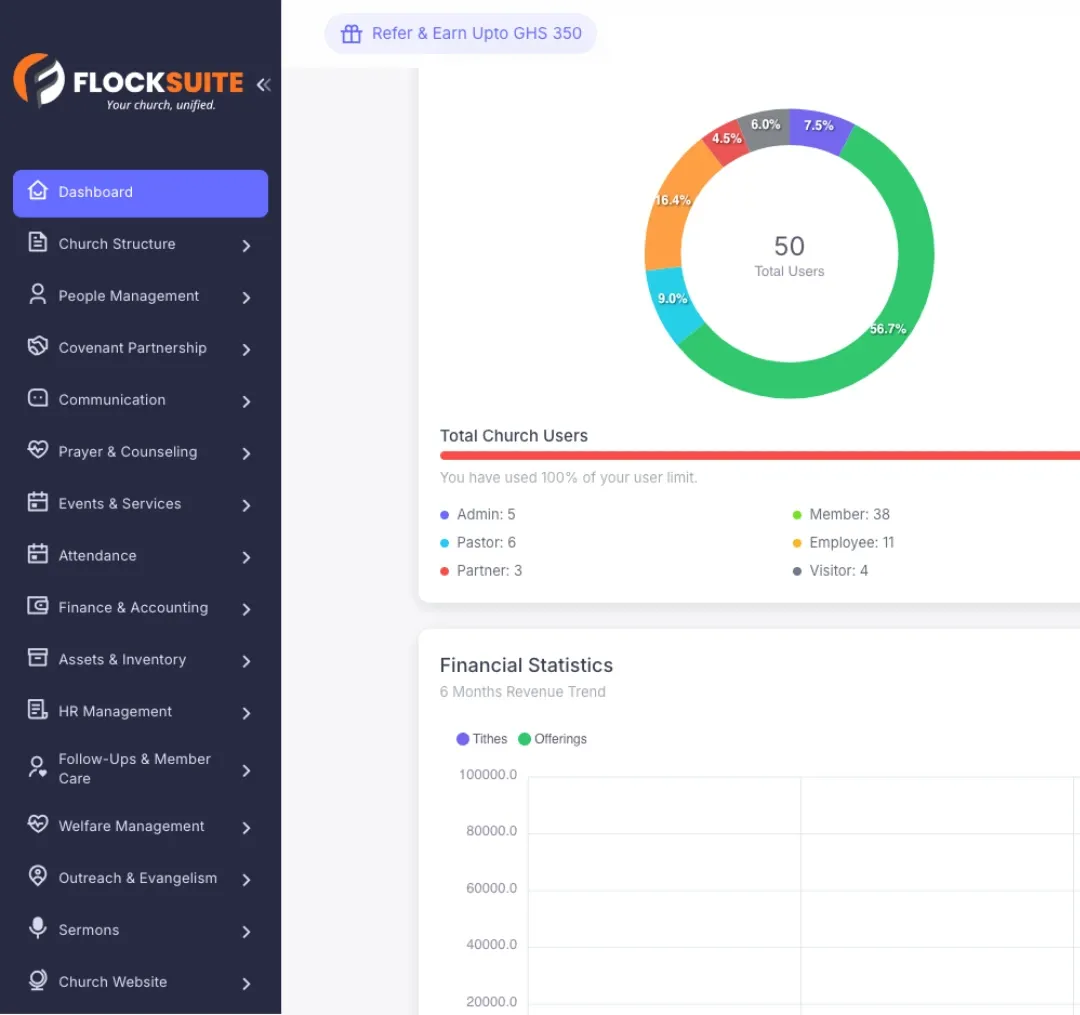
A church attendance tracker that records who was at which service, in which department, and then turns it into a trend is worth more than a hundred motivational sermons on growth. The visitor follow-up built on top of it is what actually turns visitors into members. Recording attendance by service takes seconds in FlockSuite, and the follow-up reminders run automatically. You can try the attendance tracker free and see your own trend line before you commit.
Giving records that match mobile money receipts
A church in Adum asked members to give via mobile money. The treasurer received the MoMo statements and could not match 40% of the transfers to names. People sent money from numbers that were not in the register, and the finance report never closed. A giving module that ties each transfer to a member, and each member to their giving history, fixes this at the root. You can see how giving campaigns work before you commit.
Offline and mobile-first access
Your secretary works from a phone, not a laptop. Your ushering team records attendance on a phone at the door. Your treasurer checks giving on a phone after work. Any software that assumes a desktop computer and always-on broadband will fail in Kumasi. The tool has to be mobile-first, and it has to keep working when the network stutters.
Church Management Software Kumasi: What It Costs in Cedis
The real cost of paper and airtime
Paper looks free until you price it. A church that chases 40 visitors a month by phone spends real money on airtime, and most of those calls go to voicemail because the number was copied wrong from a card. Add the hours the secretary spends transcribing registers, and the cost of paper is higher than most pastors admit.
Monthly pricing in context
FlockSuite pricing is built for Ghanaian churches, in cedis. Basic is GHS 150 a month for up to 300 members. Standard is GHS 250 a month for up to 600 members. Pro is GHS 500 a month for up to 2,000 members, with higher limits on churches, admins, storage, and SMS credits. Put that against the cost of one missed visitor, one wrong figure in the annual report, or one member who left because nobody noticed, and the software pays for itself. See the full breakdown at flocksuite.com/pricing.
How to Choose Software Without Wasting Money
Start with one department, not the whole church
The fastest way to kill a software rollout is to ask every department to adopt it at once. Start with one. Pick member records, or attendance, or giving. Get one department running well for 30 days, then add the next. A tool that wins one small victory is adopted far more easily than a tool that promises everything at once.
Test with your own data, not a demo
A demo account is useful, but it does not tell you how the software feels with your actual member list, your actual service schedule, and your actual giving records. Before you commit, load 20 real members and run one real Sunday. If the secretary can enter attendance without help, you have your answer.
Compare what exists in the Ghanaian market
There are several Ghana-focused options worth knowing. Shepherd is strong on WhatsApp and mobile money check-in, with a free tier for small churches and paid plans from GHS 99 a month. Asoriba has served over 1,000 churches, with free plans for very small congregations and USSD and NFC attendance. ChurchCast handles giving with transaction fees on mobile money and cards. My Church System has a free tier for very small churches. PastCare is built around pastoral care and multi-currency giving across Africa. Each is strong for a particular kind of church. The question is never which is best, but which is best for your church. If you run multiple branches and need finance, events, sermons, and a website in one platform, FlockSuite is built for exactly that. If you only need WhatsApp check-in, Shepherd is a fine fit. Compare honestly before you pay.
Your Next Step
Start with a 14-day trial
The right church management software Kumasi churches adopt is the one their team will actually use. From member records to financial reports, FlockSuite was built specifically for Ghanaian churches, priced in cedis, and designed for the phone your secretary already carries. Start your free 14-day trial. No setup costs, no credit card, and you can test everything before you pay.
Further reading: the Complete Guide to Church Management in Ghana, Church Management System in Ghana: A Practical Guide, and Church Management System Accra: What Works for Churches in the Capital.
Frequently Asked Questions
Is church management software expensive for a small Kumasi church?
No. FlockSuite Basic is GHS 150 a month for up to 300 members, and several Ghanaian options offer free tiers for very small congregations. When you compare the monthly cost to what a church already spends on airtime for follow-up calls and hours of manual transcription, the software is usually cheaper than the paper system it replaces.
Can we use church management software if we have an unstable network?
Yes, if you choose a mobile-first, offline-capable tool. Look for software that lets you record attendance and enter member data on a phone and sync when the connection returns. Network reliability varies across the Kumasi metropolis and further into Ashanti, so offline entry matters.
Does it work with mobile money giving?
A proper church management platform ties each mobile money transfer to a member profile, so the treasurer can reconcile giving without chasing unknown numbers. MTN MoMo, Telecel Cash, and AirtelTigo Money are all common in Ghana, and the goal is one giving record per member.
How do we get our team to actually use it?
Start with one department, not the whole church. Pick member records or attendance, get it running for 30 days, then add the next department. A tool that wins one small victory is adopted far more easily than one that is forced on everyone at once.
Do we need a website too, or just the software?
FlockSuite includes a church website builder, so a church can launch a mobile-friendly website from the same account. If your church has no website, or an outdated one, this closes that gap without hiring a developer.
Comments
No comments yet. Be the first to share your thoughts!
Leave a Comment