

Knowing how to track church attendance in Ghana is the difference between guessing and leading. Most churches still count heads with a pen and a hardcover register, and most of those numbers never leave the book.
Here is what that costs in practice. A church in Accra runs three services every Sunday. It cannot tell you whether the 6am service is growing or fading, how many first-time visitors walked in last month, or which families have quietly stopped coming. The pastor usually finds out a member has left only when somebody mentions it at a funeral.
The Church of Pentecost alone reports 20,230 local assemblies in Ghana and more than 4.4 million members as of December 2025. That scale only works because attendance is counted, reported, and reviewed at every level, every single week. Your church does not need that scale to benefit. You need a system you can actually run.
This guide walks you through a method that works with a paper register today and a digital attendance tracker when you are ready. If you would rather skip the manual work, FlockSuite handles attendance, member records, and follow-up in one place. Start a free 14-day trial, no credit card required.
How to Track Church Attendance: Start With What You Actually Need
Why you are tracking attendance matters more than how
Attendance numbers do three jobs in a healthy church. They show you who is coming, who has stopped coming, and whether the church is actually growing. If you only need a number to announce on the first Sunday of the year, a register is enough and this guide is not for you.
If you want to spot a family that has gone quiet, plan ahead for a growing children's ministry, or know which of your three Sunday services to invest in, then you need more than a total. You need a name attached to every number.
Paper registers are not your real problem
Plenty of people will tell you to throw away the register and buy software. That advice skips a step. The register is not the problem. The problem is that the register records a total and forgets the people behind it. Fix that first, with any tool.
An usher at a church in Tema once told me the register "works fine." When I asked how many first-time visitors they had in October, she opened a cupboard and spent twenty minutes counting little crosses in a book nobody had opened since October. The data was there. It was just buried.
Build Your Member Roll Before You Count Heads
What a useful member roll contains
Attendance tracking falls apart without a clean member roll. Before you count who is in the room on Sunday, you need a list of who actually belongs to the church. The roll should hold, at minimum:
- The full name of every member
- A phone number, preferably a mobile money number they actually use
- Their department or ministry group
- Their home area or district, so you can group visits
- The date they first attended
Many Ghanaian churches keep this in a WhatsApp group description or the secretary's notebook. That works until the secretary leaves, and the list leaves with her.
Assign a name to every number
A count of "312" tells you nothing. A list that shows 312 people, 47 of them first-timers, 19 of them absent for the third week running, tells you exactly where to put your effort this week. That is the entire point of attendance tracking.
How to Track Church Attendance at Every Service: Three Methods
Method 1: The counted register (works today, costs nothing)
Keep the register, but change how you fill it. Instead of one total per service, use a row per service with columns for adults, children, first-time visitors, and members present. Record it during offering time, when people are seated and easy to count. Total it the same day, not the following Sunday when the numbers have gone cold.
Method 2: Check-in cards and stickers
Give every first-time visitor a card to write their name, phone number, and how they heard about the church. Collect the cards at the welcome desk, not the offering basket. For children's church, coloured stickers by age group give you an instant count and tell you whether your 9am service runs heavier on children than adults.
Method 3: A digital attendance tracker
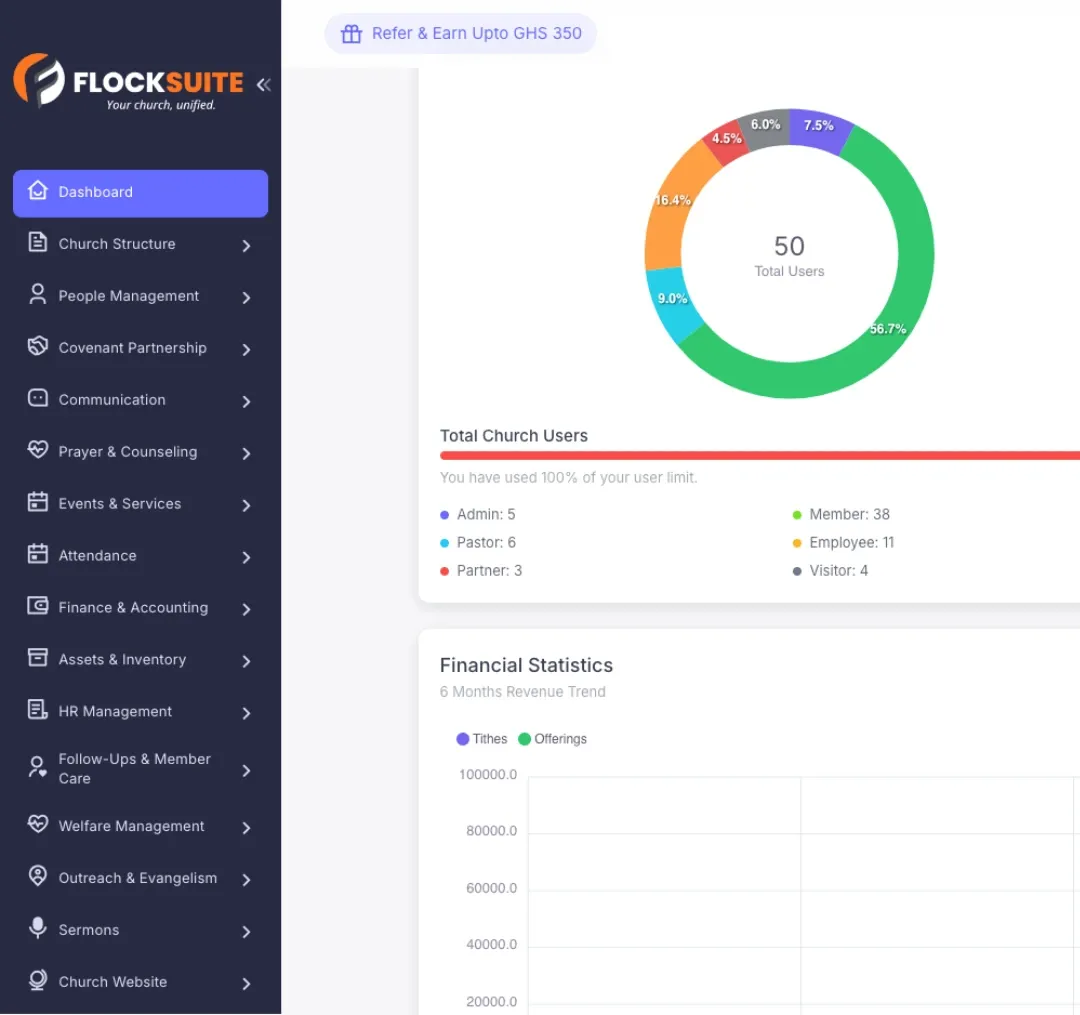
A digital attendance tracker removes the counting and the arithmetic. Members check in with a QR code or a name search, and the software totals everything for you. This matters most when you run multiple services or branches, because paper totals from three services rarely get compared at all.
The Four Attendance Numbers That Matter
Total attendance and service split
Track each service separately. A church running 6am, 9am, and 11am services often finds that one service carries the growth while another quietly declines. You cannot see that in a single total, and you cannot fix a service you cannot see.
First-time visitors versus returning members
First-time visitors are the one number that predicts next year's membership. Track them every week and follow up within 48 hours. Churches that do this keep far more visitors than churches that wait a week, or worse, do not follow up at all. Visitor follow-up is where most Ghanaian churches lose people without ever noticing.
New converts and second-timers
A first-time visitor is an interest. A second-time visitor is a relationship forming. Count second and third visits separately from first visits. It is the single clearest early signal of whether your follow-up is working.
Absentees: who has gone quiet
The most valuable list you can produce is the list of members who were regular and have now missed three straight weeks. Those are not lazy members. They are people going through something. A phone call this week costs almost nothing and saves more members than a year of better preaching.
What the Data Shows You (And What to Fix)
A worked example: children outnumbering adults
Here is a pattern I have seen in churches across Ghana. A church in Kumasi started tracking attendance by service and by age. Within a month they saw that their 9am service consistently had far more children than adults. The children's ministry was staffed for half the actual number. They moved two volunteers to that service and fixed the shortage within a week.
No software found that. A simple age column did.
Match rooms and volunteers to real turnout
Once you know your real numbers, you can stop guessing on seating, security, and volunteers. If your 11am service averages 180 and your 6am averages 40, your strongest ushers should be at 11am. If harvest season triples attendance, you now have last year's numbers to plan from instead of a memory.
Recording all of this by hand takes discipline. A digital attendance tracker does the counting and the comparison for you, and it works offline so a weak network on Sunday morning does not stop you. Try FlockSuite's attendance tracker free and see your numbers in one report.
Mistakes That Make Attendance Data Useless
Counting heads instead of people
The biggest mistake is recording a total and stopping there. A total hides everything. Two churches can both report 300 on Sunday, and one is growing while the other is shrinking. The difference shows up in first-timers, second-timers, and absentees, not in the headline number.
Recording numbers and never looking at them
The second mistake is collecting data that nobody reviews. Decide who owns the attendance report. In most Ghanaian churches that is the administrator or the secretary. Give that person one job: produce a one-page summary before the weekly leaders meeting, and flag the names of members who have gone quiet.
Moving From Paper to a Digital Attendance System
What to look for in an attendance tracker in Ghana
When you are ready to go digital, look for a few things specific to how Ghanaian churches actually run. The tool should work on a phone, because most of your leaders carry phones, not laptops. It should work offline and sync later, because network coverage is not reliable everywhere. It should handle multiple services and branches, and it should show you the four numbers above on one screen instead of making you dig for them. FlockSuite's features cover attendance, member records, communication, and giving from a single account.
What it costs, in cedis
Church management software in Ghana no longer costs thousands of cedis. FlockSuite's Basic plan is GHS 150 a month for up to 300 members, Standard is GHS 250 for up to 600, and Pro is GHS 500 for up to 2,000. For many churches that is less than they already spend on airtime for follow-up calls each month. See the full plans on the pricing page.
From the member roll to the absentee list, everything above works best when it lives in one place. FlockSuite was built for Ghanaian churches, with attendance, member records, and follow-up in a single platform, and it runs on the phones your leaders already carry. Start your free trial, no setup costs, no credit card, 14 days to try everything.
Further reading: The Complete Guide to Church Management in Ghana, How Ghana Churches Can Digitize Attendance, Tithes and Member Records, and Church Management System in Ghana.
Frequently Asked Questions
How often should we count attendance?
Every service, every week. The value is in the trend over time, not in any single Sunday. Skip a week and the trend gets noisy, which makes the numbers harder to trust.
Can we track attendance with WhatsApp alone?
You can, but it gets messy fast. WhatsApp works for announcements and quick follow-up, but it cannot give you a member roll, a service-by-service trend, or an absentee list without a lot of manual work. Use WhatsApp for communication and a proper tracker for attendance.
Do we need a computer at the church to track attendance?
No. A phone is enough for the three methods above, and any good attendance tracker should run on a phone. A laptop helps when you produce monthly reports, but it is not required to get started.
How do we track attendance for multiple branches?
Give each branch its own attendance record under one account, then compare them side by side. This is where paper fails hardest, because branch totals sit in different books and never get compared. Software built for multiple branches keeps everything in one place.
What is a good attendance rate to aim for?
Focus on the trend, not a magic number. A church that is growing keeps first-timers returning. If your second-visit rate is rising, you are healthy. If first-timers never come back, fix your follow-up before you worry about the total.
Comments
No comments yet. Be the first to share your thoughts!
Leave a Comment