


How to keep church member records is the question that quietly decides how well a Ghanaian church can care for its own people. The first time a register book is lost, left behind during a pastoral transfer, or soaked through in a leaking vestry, a church loses more than paper. It loses the single list that connects a widow to her welfare support and a first-time visitor to a follow-up call.
The Church of Pentecost reported 20,230 local assemblies across 1,804 districts in Ghana as of December 2025, with 4,464,013 members, about 13.1 percent of the national population, in its own headquarters statistics. If a denomination that size can describe every member in one annual report, your church of 300 or 3,000 can hold one accurate record for every person too.
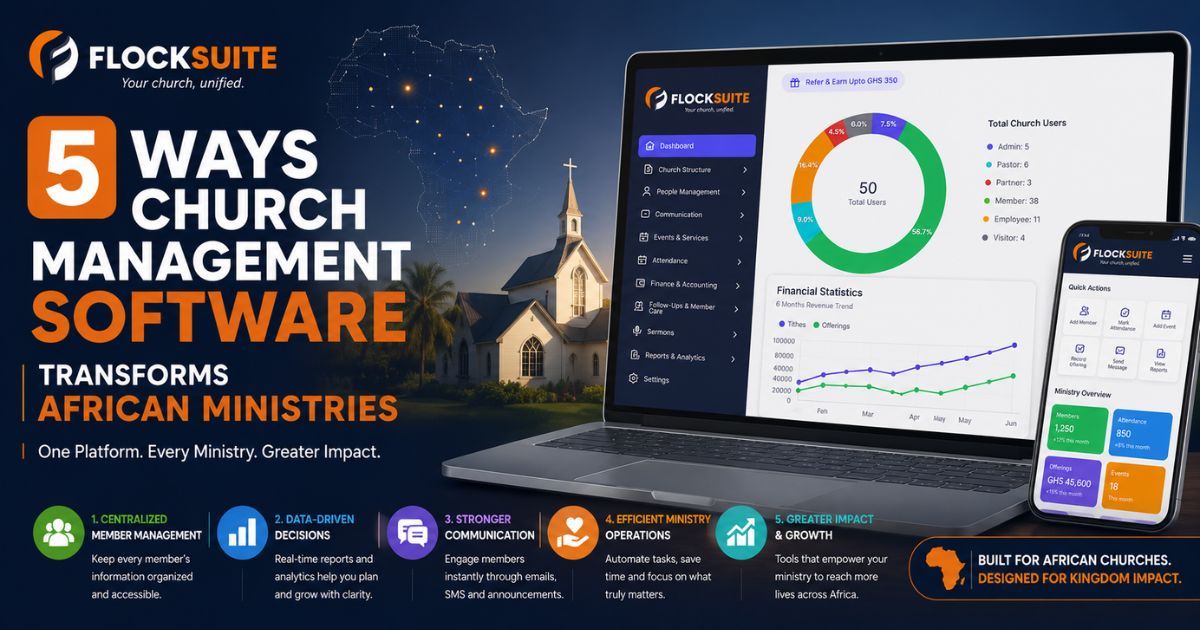
Churches across Ghana already keep those records on FlockSuite, one member record per person that an authorised leader can reach from a phone. You can start a free 14-day trial with no credit card and no setup fee while you work through this article.
How to keep church member records in Ghana: why paper fails first
Paper is not the enemy. Paper fails because a church grows faster than the one book that holds it, and because the person who kept the book is not always the person who keeps it next.
The four ways a paper register loses information
- The single copy. One book, one location. If it sits at the main auditorium in Accra, the Kumasi branch cannot check whether a new attender is already a member.
- The hand-written duplicate. A name spelled three ways, a phone number written without its leading zero, a Mr Mensah in one entry who is Emmanuel Mensah two pages later.
- The silent removal. A member moves to another town, and instead of transferring the record the secretary crosses out the line. The history disappears with the ink.
- The physical risk. Fire, water, termites and simple misplacement. A church that keeps one register keeps one point of failure.
What Ghana's own census says about movement
Members move. The 2021 Population and Housing Census found that Ghana's urban population had risen to 56.7 percent from 50.9 percent in 2010, and that almost half of that urban increase landed in Greater Accra and Ashanti alone, according to the Ghana Statistical Service. Those are work transfers, university terms and family relocations, and every one of them can move a member across your branch lines. A register that cannot follow a person across a region will lose them, along with the giving history and follow-up notes that belong to them.
One record per person, and how to stop duplicates
Duplicate records are the most expensive record problem in Ghanaian churches, and they are created by good intentions rather than carelessness.
A member stops attending your Tema assembly for two years and then returns, this time to the Accra branch. The welcome desk sees a familiar-looking new face and opens a fresh line in the book because checking Tema means making a call. The church now holds two profiles for one person, two giving totals, and a pastoral note split down the middle.
Why the same member gets registered twice
- Silent moves. The sending branch does not tell the receiving branch that someone has relocated.
- Multiple services. A member who attends the 6am prayer service and the 11am main service can be recorded by two different volunteers.
- Name variation. Official names, day names and nicknames are each written on a different form.
- Family entries. A household is entered once as a family and again as individuals, so the children exist twice.
What a workable member record contains
- Full name, plus any known alternative spelling or maiden name
- Primary phone number and one alternate contact, because SIM cards change
- Home area and current branch
- Membership status and date joined
- Baptism and conversion dates, which many churches track carefully and then bury in a book
- Departments and ministries the member serves in
- Household or family links, so children are attached to the right adults
- Follow-up notes with the date they were written
A record like this takes minutes to create and seconds to search. You can try the member records free for 14 days and load a single branch first to prove the structure works before you roll it out.
How to keep church member records safe under Ghana's data protection law
Most church leaders in Ghana are surprised to learn that their register is already governed by law, not by custom.
What Act 843 means for your register
The Data Protection Act, 2012 (Act 843) is the law that covers how organisations handle personal data in Ghana. Section 91(1) states that the Act binds the Republic, so churches are not exempt simply because they are religious bodies. The Institute of ICT Professionals Ghana sets out what this means for congregations: membership lists, baptismal records, contact details, photographs, welfare notes and children's Sunday school lists are all personal data, and they are covered whether they are held on paper, on a computer or on any other medium.
The same guidance lists the member's rights, which a church should be able to honour: to be told how their data is used, to see it, to correct it, and to ask for it to be deleted or its use restricted. None of that is difficult if your records are organised. All of it is nearly impossible if your only register is a book in a cupboard.
Five practical rules for a small church
- Collect only what you use. If you never call the alternate number, do not demand it at the welcome desk.
- Say why you are collecting it. One line on the membership form, explaining that the details are for pastoral care and church communication, is enough.
- Limit who can open the register. The pastor, the secretary and the treasurer do not all need the same fields. Giving data should be visible to fewer people than phone numbers.
- Keep it off personal phones and memory cards. A member list photographed onto a volunteer's phone leaves your control the moment that phone is sold or lost.
- Know how to delete a record. When someone asks you to remove their details, you should be able to do it in minutes and prove that you did.
Records that survive staff turnover
Ghanaian churches run on part-time and volunteer staff. A secretary serves for two years, marries, and moves to another region. A treasurer hands over after an election. If the records live in that person's head or notebook, the church hands over a gap instead of a system.
The handover problem, as it happens
Ask a church that has gone through three secretaries in five years how many members it has, and you will usually get three different answers, one for each secretary's period. Each one built a personal system, and each system died with the role. The members did not leave. The records did.
The fix is not more discipline. It is making the record belong to the church rather than to the person holding the pen. When the register lives in one shared, password-protected account, a new secretary inherits a working database on day one, not a box of cards to decipher.
A one-page handover checklist
- The login details for the central member database, held by the pastor and one other leader
- A written note naming who currently owns each phone number and mobile money wallet
- The list of members added or removed in the outgoing officer's last month, with reasons
- Any records still on paper, photographed and loaded before the handover is signed
- A named person responsible for the database going forward, and the date of the final review
A one-page checklist gets followed. A thirty-page policy gets filed. FlockSuite keeps roles and permissions attached to the church account rather than to a personal login, so access can be granted to the new secretary and removed from the old one the same afternoon. The access and reporting structure is described on the FlockSuite features page.
Make records work with patchy network and power
Any system for keeping records in Ghana has to accept that the connection will drop and the lights will go out. Record keeping that assumes a stable office computer fails the churches that need it most.
Design for the connection you actually have
- Enter records on the device in your hand, then let the data sync when the network returns.
- Keep a short offline capture sheet for services where the phone has no bars, and load it the same day.
- Never keep the only copy on a laptop that lives in an office with irregular power.
- Give the ushering and follow-up teams a way to capture details without waiting for the office to open on Monday.
Mobile first, because your members are
Digital money has already changed how members give. The Bank of Ghana reported that mobile money transaction values reached GH¢4.54 trillion in 2025, up by more than 50 percent on the previous year. When giving and communication move to the phone, the records that track them should live somewhere just as portable. FlockSuite runs in a browser on the phones your volunteers already own, so a member's details can be updated at the welcome desk, at a house visit, or in the car park after the second service, not only when the office computer is switched on. Plans start at GH₵150 a month for Basic, GH₵250 for Standard and GH₵500 for Pro, which is close to what a church already spends on airtime for follow-up calls.
How to keep church member records accurate: a 30-day cleanup
You do not have to fix everything at once. A single month of focused work will clear most of the damage in an existing register.
The four-week plan
- Week 1: load the members you are sure about. Start with active members, leaders and households. Do not try to digitise twenty years of history yet.
- Week 2: merge duplicates. Pull the list for each branch and look for repeated phone numbers, which are the clearest sign that one person has two records.
- Week 3: fill the gaps that matter. Phone number, home area, membership status and department. Skip anything you do not actually use.
- Week 4: agree the rules and stop the leaks. Decide who may add a member, who may delete one, and what to do when someone moves to another branch.
Mistakes that undo a cleanup
- Deleting the old record instead of transferring it. A move is not a resignation, and the history should follow the person.
- Letting each department keep a private list. The moment one leader keeps a separate spreadsheet, you have two versions of the truth again.
- Loading a full address for every member. In many areas a home area is enough, and demanding more slows the team down.
- Waiting for perfect data before you start. An accurate register of your active members today is worth more than a complete one you never finish.
From one member record to giving and attendance that stay attached to the right person, FlockSuite was built for churches in Ghana. Start your free trial with no setup costs and no credit card, and clean up one branch before you touch the rest. If you are still deciding what to look for, the complete guide to church management in Ghana is the place to start, and the article on managing church members pairs well with this one. Pricing for every plan is published openly on the FlockSuite pricing page.
Frequently asked questions
Where should a small Ghanaian church keep member records?
Start with one central digital record rather than several paper books. A shared, password-protected system means the pastor, the secretary and the branch leaders all read the same list, and a move between branches transfers a person's history instead of losing it. Keep any remaining paper only as a temporary capture sheet while details are entered.
Do we need consent to keep a member's details?
Yes, and it is simpler than it sounds. Tell the member what you are collecting and why, for example pastoral care and church communication, and keep only the details you actually use. The Data Protection Act, 2012 (Act 843) applies to churches and to information held on paper as well as on a computer.
How do we stop one member appearing twice?
Search by phone number before you create a new record, since a repeated number is the clearest sign of a duplicate. Then agree one rule and hold to it: a member has a single record for life, and moving between branches changes their branch field, not their identity.
What happens to records when a secretary leaves?
Nothing should happen to them if they live in the church's own account rather than on a personal laptop or notebook. Grant the new secretary access, remove the old one, and work through a one-page handover checklist so nothing walks out in a personal contact list.
Can we keep records working when the network is down?
Capture details on a phone and let the system sync when the connection returns, and keep a short paper sheet for services with no signal, entered the same day. Choose records software that works in a mobile browser, because that is the device your volunteers already have.


Comments
No comments yet. Be the first to share your thoughts!
Leave a Comment