


How to manage multiple church branches stops being a technology question and becomes a records question almost immediately. The first time a member moves from your Tema branch to your Accra branch and nobody notices, you are already running two churches that share a name.
Ghana is a multi-branch country by habit. The Church of Pentecost alone reported 20,230 local assemblies across 1,804 districts in Ghana as of December 2025, according to its own headquarters statistics. ICGC, Assemblies of God, Winners Chapel and the Methodist Church Ghana all run the same shape at a smaller scale. Your church may only have two or three branches, but the fracture points show up early and they are almost always the same four: member records, attendance, money, and communication.
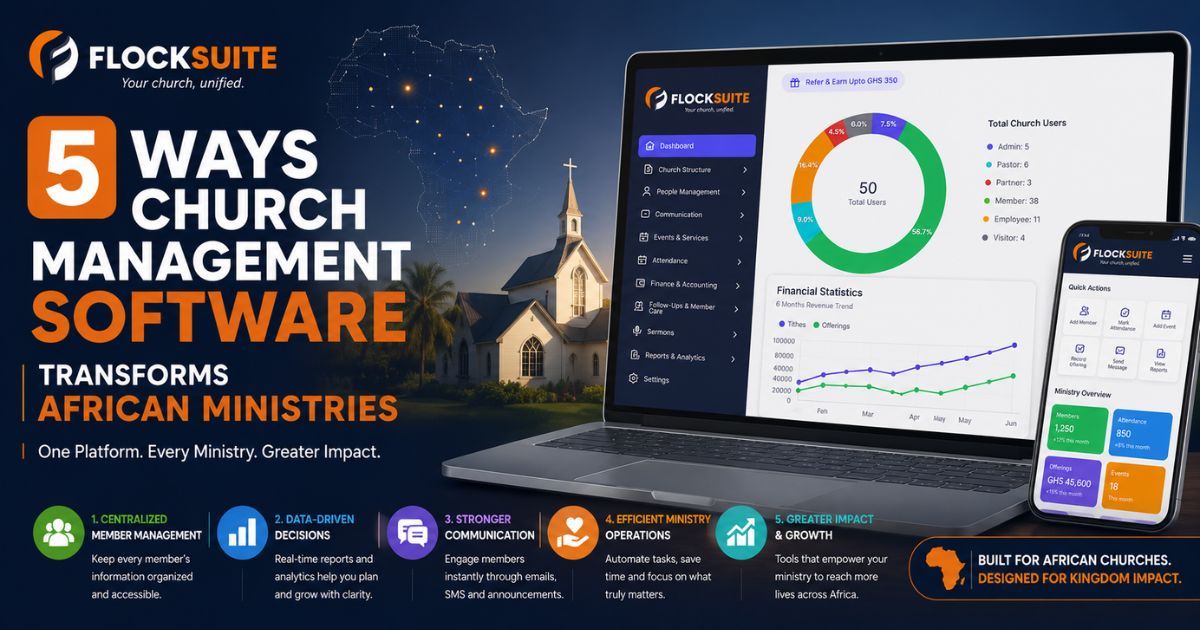
Churches across Ghana already run their branches on FlockSuite, one platform with branch-level records and a central view. You can start a free 14-day trial with no credit card and no setup fee to see how the branch structure fits before you commit.
How to manage multiple church branches in Ghana: what breaks first
Nothing dramatic happens on the Sunday you open branch two. What happens is slower and more expensive. The head office starts asking questions that nobody can answer quickly, and the branch pastor starts keeping private notes just to survive the week.
The four things that fragment first
- Member records. The mother church has a register book. The new branch starts a fresh one. A family that attends both is now two separate entries in two separate places.
- Attendance. Two registers, two counting habits, no shared definition of what counts as attendance. One branch counts children, the other does not.
- Money. Offerings are counted at each branch, banked or sent by mobile money separately, and reconciled later by whoever remembers.
- Communication. Announcements that matter to everyone are sent by WhatsApp groups that overlap badly, so some members hear things twice and some never hear them at all.
Why branch two is genuinely the hardest stage
Multi-site research from Leadership Network and Ekklesia 360 found that 85 percent of multi-site churches have only two sites. That is not because churches cannot grow past two. It is because two locations are the point where informal coordination stops working and structure has to be invented, and most churches have never had to write that structure down.
Consider a realistic case. A church in Kumasi opens a second branch in Asokwa. Within four months the head pastor is spending most of Saturday reconciling two offering sheets and chasing a member list that only the Asokwa secretary understands. Sunday morning preaching never suffered. Saturday administration did.
How to manage multiple church branches: five decisions to settle first
Before you think about software, make five decisions and write them on one page. Multi-branch churches that fail usually fail here, not in the tool they chose.
The five decisions to make before you open branch three
- One member identity per person. A member keeps one record for life, and moving between branches changes their branch field, not their identity. Without this, every move creates a duplicate.
- Who may see giving records. In most Ghanaian churches this is the pastor, the treasurer and one named administrator. Decide it in writing rather than by who happens to know the login.
- Which numbers the head pastor sees every week. Pick five and refuse to add a sixth. Attendance, total giving, new members, first-time visitors, and outstanding follow-ups will cover most of what you actually act on.
- What a branch pastor may change without asking. Service times, local events, and department heads usually belong to the branch. Prices, membership categories and giving codes do not.
- Who owns each phone number and each MoMo merchant wallet. This sounds administrative until a secretary leaves and the branch loses access to its own collection wallet.
Write it down as one page, not a policy manual
A one-page structure note gets followed. A thirty-page manual gets filed. The note should name the five decisions above, the person responsible for each, and the date it was agreed. Review it once a year at your January leaders meeting, not every quarter.
Keep one member record that follows the person across branches
The single highest-value change you can make is a shared member database with a branch field. Everything else in this guide depends on it.
The duplicate member problem in Ghanaian churches
Ghanaian congregations move more than church leaders expect. Work transfers between Accra, Tema and Kumasi, university terms, weddings, and family relocations all push members across branches. When records live in paper books at each site, a member who moves is typically re-registered from scratch, and their giving history, baptism record, department memberships and follow-up notes are lost at the moment they matter most.
A shared database changes the conversation. When someone transfers, the record moves with them, the receiving branch sees their history immediately, and the sending branch stops counting them as active in reports. FlockSuite handles this with central member records and branch-level views, so a person belongs to one church while being listed under the branch where they actually worship. If you want to see how that record is structured, the guide on managing church members walks through the fields that matter.
What a workable record actually contains
- Full name, phone number and one alternative contact, since numbers change often
- Home area and current branch, so you can plan outreach and transport realistically
- Membership status and date joined, which is what your growth numbers are built on
- Departments and ministries, so branch leaders know who is already serving
- Baptism and conversion dates, which many Ghanaian churches track carefully and then leave in a book nobody can search
Recording this once, centrally, is where the time savings start. Doing it in FlockSuite takes minutes per member and the record is instantly visible at every branch you authorise. You can try the member records free for 14 days and load one branch first.
Track attendance the way your church actually meets
Attendance is the number church leaders trust least and need most, especially when a decline starts slowly and everyone explains it away.
Count the service, not the Sunday
Ghanaian churches rarely hold one service. A 6am prayer service, a 9am main service and an 11am second service are normal, and midweek Bible study and all-night services sit on top of that. If your register has one line labelled Sunday, you cannot see which of those gatherings is actually carrying the church, and you cannot compare branches honestly. Track each service separately and you start seeing patterns within a month.
Compare branches without flattering anyone
The honest measure is not total attendance. It is the share of your registered members who showed up, plus a separate count for visitors and children. One church discovered that a single service consistently had 40 percent more children than adults, which meant the children's ministry was understaffed by roughly half every week. That is a volunteer scheduling problem that only becomes visible when attendance is recorded by service and by category instead of in one lump sum.
Branch-specific attendance reports turn this from an argument into a fact, and FlockSuite keeps them separate per branch while rolling the totals up for leadership. The article on tracking church attendance covers the counting method in detail.
Handle offerings, tithes and mobile money across branches
Money is where multi-branch churches feel the most pain, and mobile money has changed how that pain arrives.
Reconcile mobile money the same day
Ghana's Bank of Ghana data put mobile money transactions at GH¢3.6 trillion between January and October 2025, and roughly 59.7 percent of adults use a digital wallet. Interoperability, mandated in 2018, means a member can send their tithe from MTN MoMo, Telecel Cash or AirtelTigo Money to whichever wallet the church uses, with no network barriers. That is convenient for the giver and messy for the accountant, because a single Sunday can leave money sitting in three different wallets with no shared record.
The practical rule is one merchant wallet per branch, named clearly, and a daily reconciliation against recorded giving. A treasurer who reconciles same day catches a missing transfer in minutes. A treasurer who reconciles at month end is usually reconstructing events from memory and screenshots.
The branch account question
In multi-site churches, the quietest conflict is the belief that money raised at a branch belongs to that branch. Denominational structures handle this differently, and your church will have its own answer. Whatever you decide, the decision should be written, consistent, and visible in the same report format at every branch. Ambiguity here damages trust faster than any accounting error.
Give access by role, and report in ten minutes
Software does not fix multi-branch governance. It makes bad governance visible, which is useful.
Access should follow responsibility, not seniority
A branch secretary needs to add members and record attendance. A branch treasurer needs giving records. Nobody except the named leadership group needs to see the consolidated financial position of every branch. FlockSuite assigns permissions by role and keeps branch data scoped to that branch, with a central view for the people who need the whole picture. The branch-level permissions and reports are covered on the FlockSuite features page. The written decision you made earlier becomes a set of permissions, and permissions are much harder to forget than an instruction given at a leaders meeting.
A weekly report that takes ten minutes
- Attendance by service, with visitors and children counted separately
- Total giving received, split by channel, and reconciled against the wallet
- New members and first-time visitors with contact numbers captured
- Follow-ups completed and follow-ups still outstanding
- One line of commentary from the branch pastor on anything unusual
FlockSuite runs on the pricing published on its own pricing page. Basic is GH₵150 per month, Standard is GH₵250 per month, and Pro is GH₵500 per month, with higher tiers supporting more users and more branches. For most two or three branch churches, Basic or Standard is the realistic starting point, and the cost is close to what a church already spends on airtime for follow-up calls.
Mistakes that quietly undo multi-branch growth
These cost years rather than weeks, and they rarely look like mistakes at the time.
Buying for the head office only
If the platform is selected by the head office, paid for by the head office, and used only by the head office, the branches will keep their own spreadsheets within a quarter. Involve at least one branch secretary and one treasurer in the decision, and train them before launch day rather than after.
Letting each branch invent its own categories
When two branches define giving categories differently, the consolidated report becomes a negotiation every month. Set the categories centrally once, and let branches add local events underneath them.
Treating a transfer as a resignation
When a member moves to another branch, the sending branch often quietly removes them and the receiving branch registers them fresh. That single habit destroys your growth numbers and your follow-up history at the same time, and it is entirely preventable with a shared record.
Assuming cheap internet and reliable power
Network reliability still varies by region and by hour, and power interruptions are routine. Choose tools that work on a phone and tolerate a dropped connection, because the branch with the worst connectivity is usually the one that needs records most.
From one member record to branch-level giving and attendance, FlockSuite was built for Ghanaian churches running more than one location. Start your free trial with no setup costs and no credit card, and run one branch before you move the second. If you are still deciding what to look for, the complete guide to church management in Ghana is the place to start, and the workflow article on digitizing church administration pairs well with this one.
Frequently asked questions
How many branches can FlockSuite manage?
FlockSuite is used by churches running multiple campuses from a single account, with branch records, branch-specific reports and centralized oversight. The number of branches and users depends on your plan, and the higher tiers support larger organisations. Check the current limits on the FlockSuite pricing page before choosing a tier.
Do members count separately at each branch?
No, and they should not. A member holds one record for the whole church and is listed under the branch where they worship. When they move between branches, the record moves with them, so attendance and giving history stay intact instead of being recreated from scratch.
Can a branch pastor see the finances of other branches?
Only if you grant it. Access is assigned by role, so branch-level data stays scoped to that branch by default while central leadership keeps the consolidated view. This is a settings decision your church should make deliberately and write down.
How do we handle offerings sent by mobile money to different wallets?
Use one clearly named merchant wallet per branch, record giving against the member at the point it is received, and reconcile daily against the wallet statement. Daily reconciliation catches transfer errors while the details are still fresh, which month-end reconciliation almost never can.


Comments
No comments yet. Be the first to share your thoughts!
Leave a Comment