

Church Management Software Cape Coast: A Practical Guide
Church management software Cape Coast churches actually need looks different from what works in Accra or Kumasi. This is the oldest Christian city in the country. Methodism landed here on 1 January 1835 when Rev. Joseph Dunwell stepped ashore, and the Catholic Archdiocese of Cape Coast still oversees an entire ecclesiastical province. Yet most church offices in the city run on the same tools as a village chapel: a paper register, a box of welcome cards, and a treasurer's notebook.
That gap costs more than you think. The city holds about 108,000 people and sits roughly 130 km from Accra. It hosts the University of Cape Coast, whose students swell Sunday services every semester, and it draws crowds to Cape Coast Castle and the annual Fetu Afahye festival. A Cape Coast church is not managing a static list of names. It is managing a list that moves every few months.
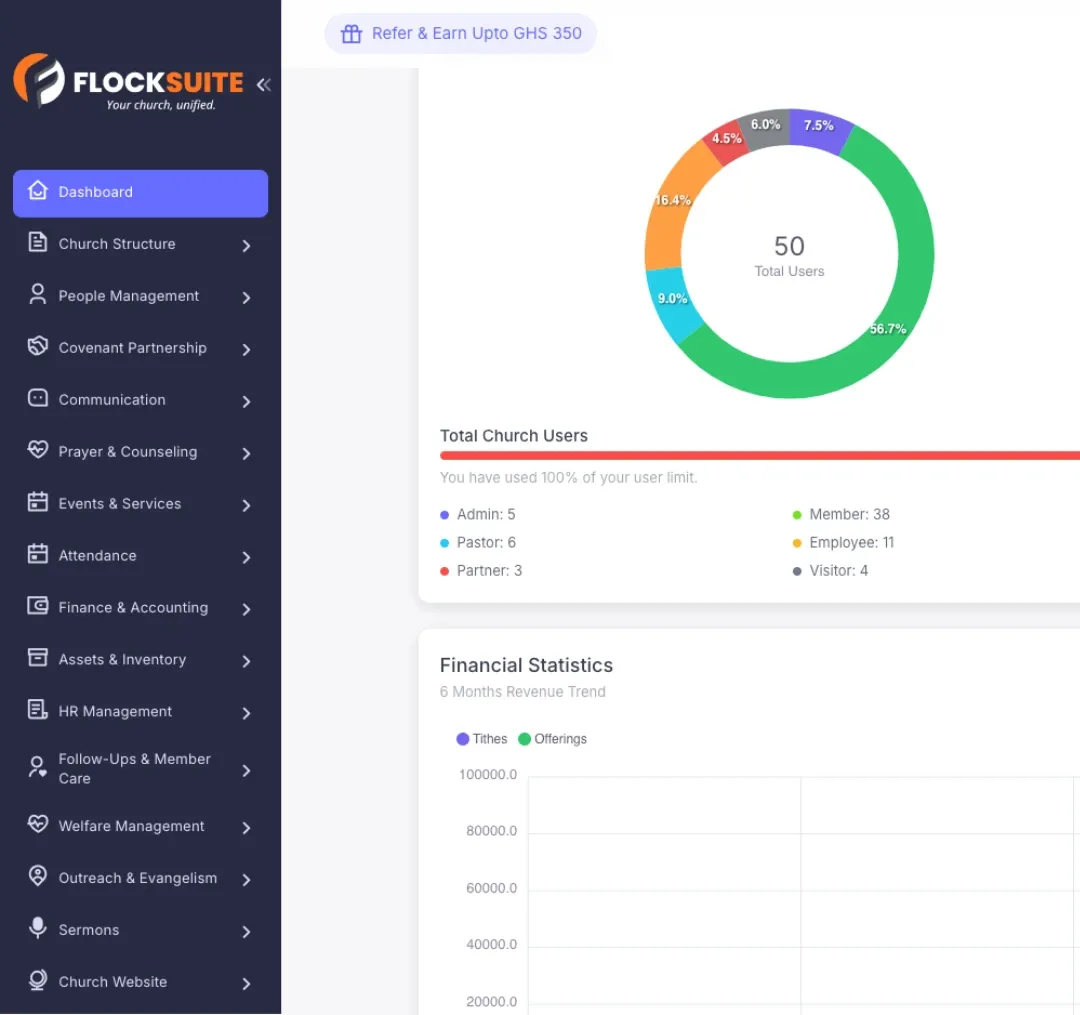
This guide explains what actually breaks down in Cape Coast church records, what software should do about it, and how to choose a tool without wasting money. If you are ready to try a system built for Ghanaian churches, start a free 14-day trial of FlockSuite. No credit card is required.
What Church Management Software Cape Coast Must Handle
The oldest church town in Ghana still runs on paper
Methodism in West Africa started here. Rev. T.B. Freeman, remembered as the father of Methodism in West Africa, used Cape Coast as his base and carried the message to Kumasi and onward into Nigeria. The Catholic Archdiocese of Cape Coast is the metropolitan see for a whole province. This is not a young church town learning the ropes. It is a town where church administration has existed for nearly two centuries.
That history cuts both ways. Many of these churches run circuits, where one superintendent minister oversees several chapels and societies spread across the city and its outskirts. Each chapel keeps its own register. Nobody sees the whole picture at once. When the denomination asks how many members the circuit has, someone adds six paper books together and hopes the number is right.
A congregation that moves every semester
The University of Cape Coast runs two campuses, the Old Site and the New Site, a few kilometres from Cape Coast Castle. Tens of thousands of students study here, many from Kumasi, Takoradi, the Western Region, and further afield. They worship in Cape Coast for nine months and then go home for the long vacation.
For a church near campus this creates a specific problem. The student who joins your choir in October is not there in July. The member whose tithe you counted for two terms has quietly returned to his home church. If your register treats everyone the same way, you cannot tell who left town, who left the faith, and who simply found another church.
Festivals, tourism, and a fishing economy
Cape Coast Castle and Elmina Castle pull in tourists and returning diaspora visitors all year. Every first Saturday in September, the Fetu Afahye festival floods the city with people. Many of your members are Fante fisherfolk whose work follows the tides, not a nine to five office schedule. A Sunday service is predictable. A midweek meeting is not.
Generic church software assumes a settled, office-bound congregation. Cape Coast is the opposite of that assumption. The tool has to handle seasonal movement, irregular schedules, and bursts of first time visitors, or it will quietly give you wrong numbers.
The Specific Problems Cape Coast Churches Face
Student members who vanish in July and August
A church near the university can lose a third of its Sunday attendance the moment the semester ends. Without a system that records whether a member is a student and where their home church is, that drop looks like decline. The pastor starts to worry the church is shrinking. In reality the members have gone home for the holiday and will be back in September, but the paper register cannot tell the difference.
The fix is simple and most churches never do it. Tag every student member with a home church and an academic status. Then when attendance falls in July, you see the drop is seasonal, not permanent. You also get a list of students to check on when term resumes. That is the difference between a record that tells the truth and a record that frightens you.
Visitor follow-up during Fetu Afahye
Fetu Afahye brings relatives home and strangers into the pews. A church might receive forty first time visitors in a single Sunday in early September. The welcome cards pile up on the secretary's desk. Three weeks later nobody has been called, and the visitors have gone back to Accra or London without ever feeling remembered.
Most churches genuinely want to follow up. They lose the cards, or the phone number is hard to read, or the secretary runs out of time. A visitor follow-up system that captures a name and number during the service, then reminds you who to call and when, changes the outcome entirely. The church that calls a visitor within 48 hours keeps far more of them than the church that calls in week three.
Multi-branch Methodist and Catholic circuits
A Methodist circuit in Cape Coast might cover six chapels. A Catholic parish might run an outstation church and a school chapel. Each location keeps its own attendance book, so the senior pastor never sees a single number for the whole circuit. When the denomination asks for a report, someone spends an evening adding books together.
Software that groups all these branches under one account gives the superintendent one view of the entire circuit. It also stops members being counted twice when they move between chapels, which happens often in a city where people worship at the chapel nearest their new house.
Church Management Software Cape Coast Pastors Should Demand
Attendance by service and by campus
Most Cape Coast churches run more than one service on a Sunday. Many run a children's service, a youth service, and a midweek prayer meeting as well. A church attendance tracker that only records one total number for the whole Sunday hides more than it reveals.
Ask for software that records attendance per service and per location. A church in Kumasi that tracked attendance by service time found its 9am service had far more children than adults and reallocated volunteers within a week. The same discovery is waiting inside your own records, but only if the software lets you see it.
Recording attendance per service takes seconds in FlockSuite, and the report shows you exactly which service is growing and which one is slipping. Try the attendance tracker free with your trial and see your own numbers for yourself.
Visitor follow-up that survives a busy Sunday
The busiest Sundays in Cape Coast are the ones where follow-up matters most. A welcome card is only useful if it becomes a phone call within two days. Software should let an usher capture a name and number on a phone during the service, then hand the secretary a clean list of who to contact and when. If the tool cannot do that, you have bought a filing cabinet, not a follow-up system.
Mobile money giving records
Most giving in Ghana now moves through MTN MoMo, Telecel Cash, or AirtelTigo Money. That is convenient for the giver and a headache for the treasurer, who has to match a stream of mobile money notifications to a member's name. Good software lets a member give through the platform and records the transaction against their profile automatically. The treasurer then spends Sunday evening reading a report instead of typing names into a notebook. FlockSuite also tracks giving campaigns, from building funds to harvest pledges.
How to Choose Software Without Wasting Cedis
Count the real monthly cost
Price in cedis, not dollars. Compare the monthly fee against what the church already spends on airtime for follow-up calls and on printing paper registers. FlockSuite starts at GHS 150 a month for up to 300 members, which is roughly a Sunday airtime budget in many churches. See the full breakdown on our pricing page. A tool that saves the secretary three hours a week pays for itself quickly. A tool that costs more than the church's entire stationery budget every month does not.
Check offline behaviour
Power and data are not guaranteed everywhere in the Central Region. A church in a coastal fishing community may lose network for an afternoon. Ask whether the software lets you record attendance offline and sync when the connection returns. If it demands a live connection for every action, it will fail you on the exact Sunday you need it most.
Ask how it handles branches
If you run a circuit, a parish, or a church with more than one campus, the software must group locations under one account and still report them separately. Otherwise you are back to adding books together. Test this during the trial with two branches, not after you have paid.
A Migration Plan That Works for a Cape Coast Church
Weeks one and two: digitise the register first
Do not try to move everything at once. Start with the member register. Enter every current member's name, phone number, and department, and mark the students and their home churches as you go. This is the boring part and it is the part that makes everything else work. A secretary can do it in a few evenings if the tool imports a spreadsheet or a CSV file.
Weeks three and four: run attendance and follow-up in parallel
Once the register is in, begin recording attendance per service and capturing visitors on the same phone. Run the new system alongside the paper book for one month. Compare the two at the end and fix the gaps. By week four most churches drop the paper book because the digital record is already more complete.
Common Mistakes Cape Coast Churches Make
Buying features instead of fixing a process
A church buys software with thirty features, uses three of them, and calls the purchase a failure. The opposite is the right order: fix the process first, then find the tool. Decide what you will actually do every week, record attendance, call visitors, send giving reports. Then buy software that does those three things well. Extra features you never open are just noise you paid for.
Ignoring the student ministry
Cape Coast churches near the university often treat students as temporary and forgettable. That is a strategic mistake. A student you disciple well becomes an alumni who supports the church and recommends it for years. Record their home church and their course, check in during breaks, and they stop being a statistic and become a long term relationship.
From the register to the giving report, FlockSuite was built for churches like yours, churches with multiple services, seasonal members, and mobile money giving. Start your free 14-day trial at flocksuite.com. No setup cost, no credit card, and time to try every feature.
To go deeper, read our Complete Guide to Church Management in Ghana, or see how churches in nearby cities are doing it: Church Management Software Takoradi and Church Management Software Kumasi.
Frequently Asked Questions
How much does church management software cost in Cape Coast?
FlockSuite starts at GHS 150 a month for up to 300 members, with higher tiers for larger churches and multi-branch circuits. Most churches find this is less than they already spend on airtime and printed registers.
Can FlockSuite handle a church with more than one branch?
Yes. You can group multiple branches, chapels, or campuses under one account and still pull a report for each location separately, which suits the circuit and parish structure common in Cape Coast.
Does the software work when the internet is down?
Attendance and member records should be captured even with a weak or lost connection, then synced when the network returns. Check this behaviour during the free trial, especially if your church is in a coastal or outlying community.
Will I lose my paper records when I switch?
No. You move your existing register into the system once, usually by importing a spreadsheet, and the paper book becomes a backup rather than the only copy.
Comments
No comments yet. Be the first to share your thoughts!
Leave a Comment