


Learning how to communicate with church members in a Ghanaian church is less about buying a tool and more about matching the message to the channel. A pastor in Tema can shout the same announcement from the pulpit, drop it into a WhatsApp group, and pay for an SMS blast, and still watch half the congregation miss it. The problem is almost never the wording. It is that one channel cannot carry every kind of message to every group of people.
I have set up communication routines for churches of 40 and churches of 4,000 across Accra, Kumasi, Takoradi, and Tamale. The pattern is consistent. Where communication fails, it fails at routing, not at effort. This guide is about fixing the routing.
How to communicate with church members without adding to the noise
Most church offices do not have a communication problem, they have a distribution problem. The announcement was made, the flyer was shared, the message was sent, and yet the youth did not show up for rehearsal and the ushers arrived without their new rosters. The information existed. It simply did not reach the person who needed to act on it.
The 400-member WhatsApp group problem
A church in Accra with roughly 400 members decided that one WhatsApp group could serve the whole congregation. Within three months the group was carrying more than 600 messages in a single week, most of them "Amen", birthday photos, and prayer requests, with the real announcements buried in the scroll. When the secretary posted a change to the Saturday vigil start time, fewer than 90 people saw it before they had already left home.
WhatsApp is not the problem. A single group for a whole congregation is. Group chat rewards chatter, and announcements need quiet. Mix the two and the important message loses to the friendly noise every time.
- One group for the whole church turns announcements into background noise.
- Members who joined late never scroll back to older pinned notices.
- People mute the group, then miss the one message that mattered.
- Nobody can tell you who actually read the notice.
What a missed message actually costs
Ghanaian churches run on volunteers who also hold jobs, trade in markets, and do school runs. When a message does not reach an usher, a choir member, or a department head, the cost shows up as an empty seat, a late start, or an evening lost to follow-up calls. A single missed rehearsal is irritating. A pattern of missed messages is how members quietly stop feeling connected and drift away.
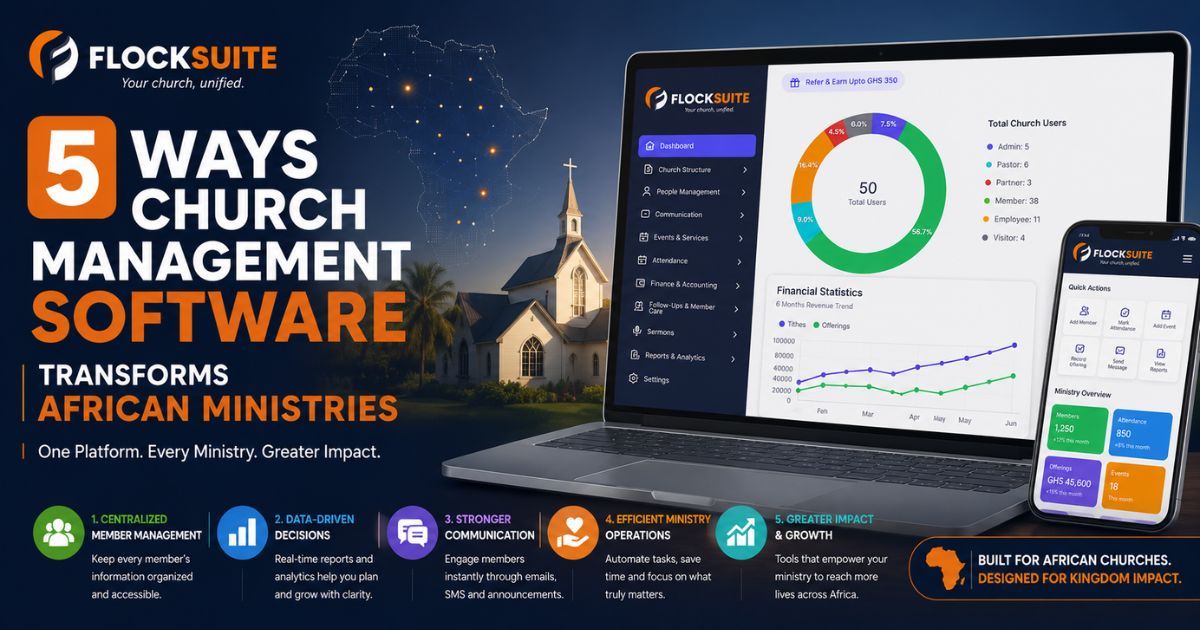
FlockSuite keeps member records, group messaging, SMS and announcements in one place so the right message reaches the right group. You can start a free 14-day trial and test it with your own department lists.
WhatsApp groups vs SMS vs announcements vs the pulpit
No single channel wins. The work is to know which one suits which message. Here is the honest comparison, written for Ghanaian conditions rather than for a brochure.
Where WhatsApp works, and where it breaks
WhatsApp is free, nearly everyone with a smartphone has it, and it carries images, voice notes and documents. For a small team coordinating in real time, a choir rehearsal group or an ushering captains group, it is hard to beat.
It breaks in three places. First, it needs data. A member with no bundle and no Wi-Fi simply will not receive the message until they buy data. Data cost is a real constraint for members on tight budgets, and it makes WhatsApp unreliable for time-critical notices. Second, it needs a smartphone, and DataReportal's 2026 Ghana report found that while 26.3 million people were online by the end of 2025, roughly 8.95 million people were still offline entirely. If your church is a cross-section of your community, a meaningful share of your members are not on WhatsApp at all.
Third, as the 400-member group showed, scale kills its usefulness for announcements. Use WhatsApp for conversation. Use it for the notice only when every member in that group is online and expected to act within the hour.
When SMS is the only channel you can trust
SMS works on the cheapest phone in the market, needs no data, no smartphone and no app. DataReportal put Ghana at 41.8 million mobile connections, about 119% of the population, which is the practical reason SMS still reaches almost everyone you are trying to contact.
SMS is the channel for the messages that must land: a change of service time, a branch relocation, a funeral announcement, a call to an emergency prayer meeting. It is also the channel you can audit. You know how many messages were delivered, and you can send the same notice to the exact segment that needs it.
Printed notices and pulpit announcements
The pulpit is still the most respected channel in most Ghanaian churches, but it only reaches the people in the room at that service. With a 6am, 9am and 11am pattern, an announcement made once reaches a third of the church. If it is important, it has to be repeated at every service, and the wording has to stay identical so people do not think it is a different event.
Printed bulletins and notice boards still matter for members without phones and for anything people need to read twice. Treat paper as a backup for the specifics, not the main carrier.
How to communicate with church members without wasting the SMS budget
SMS costs money, and most churches waste it by sending everything to everyone. A little discipline at the segment level cuts the bill far more than haggling over a tenth of a pesewa can.
What an SMS really costs in Ghana
Providers bill per 160-character segment, so a 200-character message counts as two messages, not one. Published Ghanaian rates sit in a tight band: Sailup charges a flat GH0.02 per SMS to MTN, Telecel and AirtelTigo, Hubtel ranges from GH0.0151 to GH0.0303 depending on the network, Arkesel runs GH0.0219 to GH0.031 by tier, and eSMS Africa starts around GH0.065. You can check the current comparison at Sailup's published rate comparison.
Work out what that means for your church. A 300-member reminder to one department at GH0.02 comes to about GH6. A 1,000-person weekly notice sent four times a month costs roughly GH80. That is a real budget line, which is exactly why sending the ushering notice to the whole church is an expensive habit.
Budgeting a monthly SMS plan for your church
- Segment before you send so each notice goes only to the people who must act on it.
- Keep messages under 160 characters to avoid paying double.
- Reserve SMS for time-critical and personal notices, and let WhatsApp and announcements carry the rest.
- Buy credits in bulk from a local provider and track the spend against a monthly cap.
- Audit who received what, so the same reminder is not paid for twice.
How to segment church members by department and branch
Segmentation is the single change that fixes most communication complaints. Instead of one list of everyone, you build small lists that reflect how the church actually works.
Why one list is a mistake
A single all-members list forces you to send every message to everyone, which raises cost, raises noise, and lowers response. When the children's ministry needs volunteers for a harvest rehearsal, the men's fellowship does not need the message, the ushers do not need it, and the 200 members who live two hours away do not need it. Sending it to all of them trains people to ignore you.
A worked example from a Kumasi church
A church in Kumasi with a main auditorium and a growing branch in Asokwa kept one SMS list and one WhatsApp group. Notices went to all 680 contacts, and the Asokwa branch complained that it never got branch-specific information. When they segmented, they built these groups:
- Branch, main auditorium and Asokwa separately.
- Department: ushering, choir, youth, children's ministry.
- Fellowships: men, women, and the prayer band.
- Leaders: department heads and branch coordinators only.
The first result was a lower SMS bill, because most notices now went to one segment instead of the whole church. The second result was better attendance at rehearsals, because the message finally sounded like it was addressed to the person reading it. FlockSuite supports this with member records, department assignments and group messaging, and the pricing is plain: Basic at GH150 per month for 300 users, Standard at GH250 for 600 users, and Pro at GH500 for 2,000 users. You can see the tiers on the pricing page.
If your church runs more than one site, the same segmentation logic carries across locations, and it is the foundation of good multi-branch management.
Once your segments exist, sending is fast. You can send a segmented notice free for 14 days and see how it lands with one department before rolling it out church-wide.
Notice discipline: the rules that make messages land
Channels and segments decide who gets a message. Discipline decides whether they act on it. Three rules do most of the work.
The 72-hour rule and the repeat rule
Send any notice that requires action at least 72 hours before the event, then repeat it once. The first message plants the date. The repeat catches the people who were busy the first time. For anything that changes a service or a meeting, send it three times: three days out, one day out, and the morning of. Repetition is not nagging when the message is important.
Choosing the right time of day
Ghana runs on early mornings and evenings. A 6am service means many members are already up by 5am. A notice sent at 6am or around 7pm when people are home from work and trade tends to get read. Avoid mid-afternoon, when network can be patchy and people are in the middle of the day. Build in a fallback, because power cuts and patchy network mean a message sent at 7pm might only deliver when the network returns. If a notice is genuinely urgent, pair SMS with a call to the department head, and let that person confirm receipt back to the office.
Keep a member contact record so messages reach the right people
Every channel above is only as good as the contact data behind it. A segment is worthless if half the phone numbers are wrong or missing a digit.
What belongs in a member record
- Full name and a working mobile number, ideally the number they actually use for MoMo.
- Department and fellowship, so they land in the right segment automatically.
- Branch or campus, for multi-site churches.
- Service preference, so service changes go only to the people affected.
- Family links, which matter for children's ministry and for pastoral follow-up.
- Consent note, recording that the member agreed to receive messages.
Mobile money has made phone numbers central to church life. The Bank of Ghana reported that mobile money transaction value reached GH4.54 trillion in 2025, with 26.7 million active customers, so the number saved against a member's name is also the number they use for giving. Keep it current.
Keeping records clean and current
Set a simple review rhythm. Ask members to confirm their number once a year, often at harvest or at the start of a convention, and update the record the same day. When a number bounces from an SMS send, fix it before the next campaign rather than after. A church that treats its member list as a living record spends far less on wasted SMS and reaches far more of the people it is trying to serve. This is the same discipline behind good church member management.
FlockSuite was built for exactly this, with member records, department and branch grouping, SMS, announcements and attendance in one platform, priced for Ghanaian churches rather than converted from dollars. Start your free 14-day trial, with no setup cost and no card required. Further reading: the Complete Guide to Church Management in Ghana.
Frequently asked questions
Is WhatsApp enough for church communication in Ghana?
No. WhatsApp is excellent for small, active groups that are online and expected to respond quickly, but a single group for a whole congregation becomes noisy, and roughly a quarter of Ghanaians were still offline at the end of 2025. Use WhatsApp for conversation, and pair it with SMS for the notices that must reach everyone.
How much does it cost to send SMS to church members in Ghana?
Published rates sit between about GH0.02 and GH0.065 per message, billed per 160-character segment. At GH0.02, a 1,000-person notice sent weekly costs roughly GH80 per month. Keeping messages short and sending to segments rather than the whole church is what keeps the bill down.
How should a church organise members into groups for messaging?
Build segments by branch, then by department and fellowship. Add a leaders-only segment for the messages that should not go to the whole church. Each member should sit in the few groups that match their real role, so a notice only reaches the people who need to act on it.
What should a member contact record include?
At minimum, a full name, a working mobile number, department and fellowship, branch, and a note that the member agreed to receive messages. For multi-branch churches, add the campus and service preference so time-sensitive notices go only to the people affected.
How often should a church message its members?
Send when there is something worth acting on, not on a fixed quota. The practical rule is at least 72 hours before any action, repeated once, and three times for anything that changes a service or a meeting. Too many low-value messages train members to ignore the channel.


Comments
No comments yet. Be the first to share your thoughts!
Leave a Comment